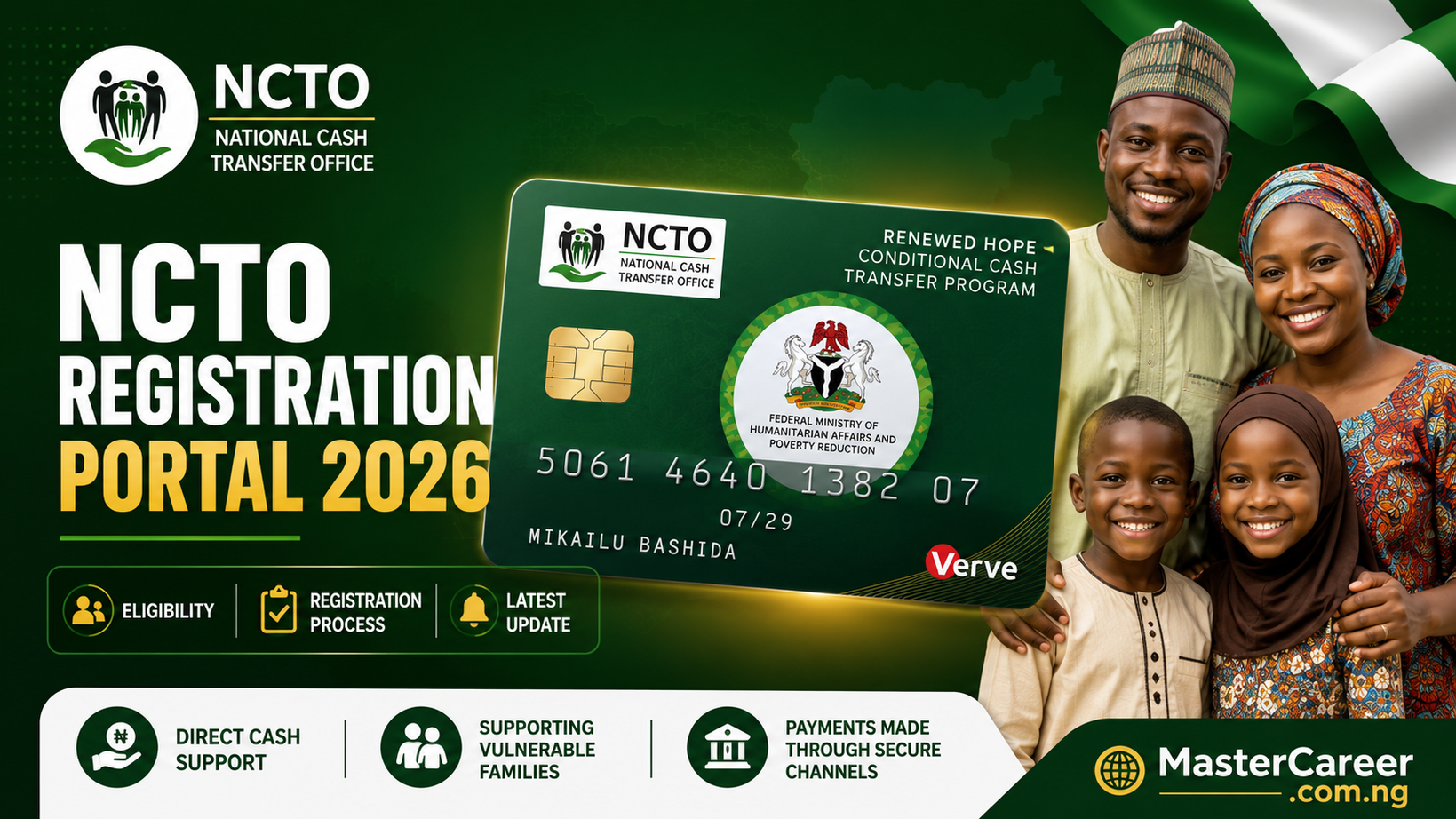
NCTO Registration Portal 2026: Eligibility, Registration Process & Latest Update
Welcome to mastercareer.com.ng, Are you looking for the NCTO Registration Portal 2026? Learn who is eligible, how the National Cash Transfer Office registration works, where to register, and the latest official updates for the RRR/CCT programme.
NCTO Registration Portal 2026: Eligibility, Registration Process & Latest Update
Are you searching for the NCTO Registration Portal 2026 or wondering how to register for the Federal Government’s National Cash Transfer programme?
Many Nigerians have been searching online for the official registration portal after hearing about the government’s Conditional Cash Transfer (CCT) and Rapid Response Register (RRR) initiatives. Unfortunately, there is a lot of misleading information online, with some websites claiming to offer registration links or asking applicants to pay a fee.
This guide explains everything you need to know about the National Cash Transfer Office (NCTO) registration process, who qualifies for the programme, whether there is an online application portal, and how eligible households are selected.
If you’re hoping to benefit from the programme, this article will help you understand the correct registration process and avoid common scams.
Latest Update: As of the latest official information, there is no public online registration portal where individuals can submit applications directly for the NCTO Conditional Cash Transfer Programme. Beneficiaries are identified through the National Social Register (NSR) and community-based targeting processes coordinated by state and local structures.
NCTO Registration 2026 at a Glance
| Item | Details |
|---|---|
| Programme | National Cash Transfer Programme (HUP-CCT) |
| Coordinating Agency | National Cash Transfer Office (NCTO) |
| Registration Method | Community-based enrolment through the National Social Register |
| Online Registration | No public online application portal |
| Eligibility | Poor and Vulnerable Households (PVHHs) |
| Beneficiary Selection | National Social Register (NSR) |
| Official Website | https://ncto.gov.ng |
What Is the National Cash Transfer Office (NCTO)?
The National Cash Transfer Office (NCTO) is the government agency responsible for implementing the Household Uplifting Programme – Conditional Cash Transfer (HUP-CCT).
The programme was introduced by the Federal Government to provide financial support to poor and vulnerable households across Nigeria.
Rather than offering loans, the programme provides direct cash assistance to eligible households to help improve their standard of living and reduce extreme poverty.
The National Cash Transfer Office works with federal, state, and local government structures to identify eligible beneficiaries and ensure that payments reach the right households.
What Is the Purpose of the Programme?
The programme aims to:
- Reduce poverty among vulnerable households.
- Improve household income.
- Support children’s education and healthcare.
- Promote financial inclusion.
- Improve the welfare of low-income families.
- Strengthen social protection across Nigeria.
Through these objectives, the Federal Government seeks to support households that face significant economic challenges.
Who Is Eligible for the NCTO Programme?
Not everyone can automatically benefit from the programme.
The National Cash Transfer Programme primarily targets Poor and Vulnerable Households (PVHHs) identified through government social protection databases.
Households may be considered based on factors such as:
- Income level.
- Household vulnerability.
- Community verification.
- Information captured in the National Social Register.
- Recommendations from community structures involved in the registration process.
Meeting these conditions does not automatically guarantee selection, as beneficiary identification follows an official verification process.
Is the NCTO Registration Portal 2026 Open?
This is one of the most frequently asked questions by Nigerians.
The simple answer is:
There is currently no public online registration portal where individuals can independently apply for the NCTO Conditional Cash Transfer Programme.
Instead, registration and beneficiary identification are carried out through official government structures at the community, local government, and state levels.
If the Federal Government introduces an online self-registration platform in the future, it will be announced through official government channels.
Applicants should therefore be cautious of websites or individuals claiming to provide unofficial registration links.
Why There Is No Online Application Form
Many people expect to complete the registration online because most Federal Government programmes now use online portals.
However, the National Cash Transfer Programme follows a different approach.
Instead of accepting applications directly from individuals, the programme identifies eligible households through the National Social Register (NSR).
The register is compiled using community-based targeting exercises carried out by trained officials in collaboration with state governments and local communities.
This approach helps ensure that assistance reaches households considered most vulnerable according to the programme’s eligibility criteria.
How Does NCTO Registration Actually Work?
Although there is no online application form, that does not mean registration is impossible.
The process generally involves several stages coordinated by government agencies and community representatives.
These stages include:
- Community sensitisation.
- Household identification.
- Data collection.
- Verification.
- Inclusion in the National Social Register.
- Beneficiary validation.
- Payment processing for eligible households.
Each stage is designed to ensure that only qualified households benefit from the programme.
How to Register for the NCTO Programme in 2026
One of the biggest misconceptions about the National Cash Transfer Office (NCTO) programme is that anyone can visit a website, fill out an online form, and immediately become a beneficiary.
This is not how the programme works.
Unlike many Federal Government empowerment programmes, the NCTO Conditional Cash Transfer (CCT) Programme does not currently have a public online application portal where individuals can register directly. Instead, eligible households are identified through the National Social Register (NSR) using a community-based targeting process coordinated by federal, state, and local government structures.
If you believe your household qualifies, here’s how the registration process generally works.
Step 1: Confirm Whether Registration Is Ongoing in Your State
Registration into the National Social Register is not conducted nationwide at the same time.
Instead, it is carried out in phases depending on the state’s implementation schedule.
You can make enquiries through:
- Your State Ministry responsible for social protection or planning.
- The State Cash Transfer Unit (SCTU).
- The State Operations Coordinating Unit (SOCU).
- Your Local Government Area (LGA) officials handling social intervention programmes.
These offices can tell you whether household data collection or enumeration is ongoing in your community.
Step 2: Participate in Community Enumeration
Where registration is active, trained enumerators or community facilitators visit communities to identify poor and vulnerable households.
During this exercise, they may collect information such as:
- Household size.
- Source of income.
- Occupation.
- Housing condition.
- Number of children.
- Persons living with disabilities.
- Other socio-economic information used for assessment.
The purpose is to determine whether a household qualifies for inclusion in the National Social Register.
Step 3: Present Required Information
Although requirements may vary slightly, households should be ready to provide basic information such as:
- National Identification Number (NIN), where available.
- Phone number.
- Residential address.
- Means of identification (where requested).
- Household information.
Providing accurate information is important because all submitted data may be verified before beneficiaries are selected.
Step 4: Household Verification
After data collection, government officials review and verify the information submitted.
This verification helps ensure that only eligible households are added to the National Social Register.
Applicants should note that participating in the enumeration exercise does not automatically guarantee that they will become beneficiaries.
Step 5: Inclusion in the National Social Register (NSR)
Households that successfully meet the programme’s eligibility criteria may be added to the National Social Register.
The NSR serves as the primary database used to identify beneficiaries for several Federal Government social protection programmes, including the National Cash Transfer Programme.
Step 6: Beneficiary Selection
When funds become available for a particular intervention, beneficiaries are selected from the verified National Social Register.
Selected households may then receive further communication regarding payment arrangements or programme participation.
Because selection is based on verified records and programme criteria, being on the register does not always mean immediate payment.
Related Articles;
Power Force Programme 2026 Application Portal Open: Apply for FG Free Technical Training
SMEDAN Free CAC Registration Portal 2026: How to Apply for FG 250,000 MSMEs Programme
Call for Applications: Bow Seat True Blue Fellowship Program 2027 (Up to $2,500 Funding)
FG NJFP 2026: Apply for ₦150,000 Monthly Jubilee Fellowship Programme
Dangote Refinery Graduate Trainee Programme 2026 Opens for Application
Apply For FG TVET Program 2026: Batch B Registration, Requirements & Payment Details
How Are Beneficiaries Selected?
Many Nigerians ask:
“How do I know if I will be selected?”
Beneficiary selection is not done randomly.
Government agencies generally consider factors such as:
- Poverty and vulnerability status.
- Household verification results.
- Community validation.
- Availability of programme slots.
- Budget and approved beneficiary targets.
This process is designed to ensure that assistance reaches households most in need.
How to Confirm Your Registration Status
If you have already participated in household enumeration, you can make enquiries through:
- Your State Cash Transfer Unit (SCTU).
- Your State Operations Coordinating Unit (SOCU).
- Your Local Government Cash Transfer Facilitator.
- Community leaders involved in the enumeration exercise.
At present, there is no public online portal where individuals can log in and check their registration status directly.
Common Mistakes to Avoid
To improve your chances of a smooth registration process, avoid the following mistakes:
- Paying anyone to register you.
- Using unofficial websites claiming to offer online registration.
- Providing false household information.
- Submitting forged documents.
- Sharing your BVN, ATM PIN, or bank passwords with anyone.
Remember that genuine registration and beneficiary identification under the NCTO programme are free of charge.
Important Notice
If you come across a website or social media post claiming to offer an “NCTO Registration Form 2026″ for a fee or asking you to submit sensitive banking details, treat it with caution.
According to the official programme guidance, there is no approved public online self-registration portal for the National Cash Transfer Programme. Any future changes to the registration process will be announced through the official NCTO website and relevant government channels.
How Do NCTO Beneficiaries Receive Their Payments?
After a household has been successfully verified and selected, the National Cash Transfer Office (NCTO) begins the payment process in line with the approved programme guidelines.
Payments are not made immediately after registration. Beneficiaries must first complete all verification and validation processes before any funds are disbursed.
Depending on the intervention, eligible households may receive payments directly into their bank accounts, approved digital wallets, or through other payment channels approved by the government. The exact payment method depends on the specific cash transfer programme being implemented.
When Will NCTO Payments Begin?
This is one of the most searched questions by applicants.
The truth is that there is no single nationwide payment date announced for every beneficiary.
Instead, payments are usually made:
- In batches.
- State by state.
- According to verified beneficiary lists.
- Based on available programme funding.
If your household has been selected, you are advised to monitor your registered bank account, phone number, and official programme updates for payment notifications.
How to Know If You Have Been Selected
If your household has been enrolled into the National Social Register, you may be contacted during beneficiary validation.
Depending on the programme phase, successful beneficiaries may receive updates through:
- Their State Cash Transfer Unit (SCTU).
- Community Cash Transfer Facilitators.
- SMS notifications.
- Official announcements from the National Cash Transfer Office.
There is currently no public website where individuals can search for their names on a beneficiary list. Beneficiary confirmation is handled through official programme structures.
Beware of Fake NCTO Registration Websites
As interest in the programme grows, fraudsters often create fake registration portals and social media pages claiming to offer:
- Instant registration.
- Guaranteed selection.
- Fast payment.
- Beneficiary approval.
Some even request payment before “processing” applications.
Remember:
- Registration into the programme is free.
- NCTO does not appoint agents to sell forms.
- Do not pay anyone to register you.
- Never disclose your ATM PIN, BVN, password, or OTP to anyone.
- Always verify information through the official NCTO website.
Frequently Asked Questions
Is the NCTO Registration Portal 2026 Open?
There is currently no public online registration portal for individuals to apply directly. Registration is carried out through the National Social Register and community-based targeting process.
Can I Register Online?
No. At the moment, there is no approved online self-registration platform for the National Cash Transfer Programme.
Who Is Eligible?
The programme is designed for Poor and Vulnerable Households (PVHHs) identified through the National Social Register after community verification.
Is Registration Free?
Yes.
The Federal Government does not charge any fee for registration or beneficiary selection.
Can I Register If My Name Is Not on the National Social Register?
You cannot apply directly through a public website. If community enumeration or registration is taking place in your area, contact your State Cash Transfer Unit (SCTU), State Operations Coordinating Unit (SOCU), or Local Government officials to enquire about the process.
How Much Do Beneficiaries Receive?
The payment amount depends on the specific cash transfer programme being implemented. Different interventions may have different benefit amounts and payment schedules announced by the Federal Government.
How Can I Get the Latest NCTO Updates?
Visit the official National Cash Transfer Office website regularly for verified announcements and programme updates.
Conclusion
The NCTO Registration Portal 2026 remains one of the most searched topics among Nigerians seeking information about the Federal Government’s cash transfer programme. However, it is important to understand that the programme does not currently use a public online application portal.
Instead, eligible households are identified through the National Social Register using community-based targeting and verification. If you believe your household qualifies, make enquiries through the appropriate state or local government structures and rely only on official information.
Avoid fake websites, do not pay anyone for registration, and always verify updates through the National Cash Transfer Office.
Disclaimer
This article is published for informational purposes only. We are not affiliated with the National Cash Transfer Office (NCTO), the Federal Ministry of Humanitarian Affairs, or any government agency. Programme information may change over time, so applicants should always rely on official government announcements and the official NCTO website for the latest updates.
1 thought on “NCTO Registration Portal 2026: Eligibility, Registration Process & Latest Update”