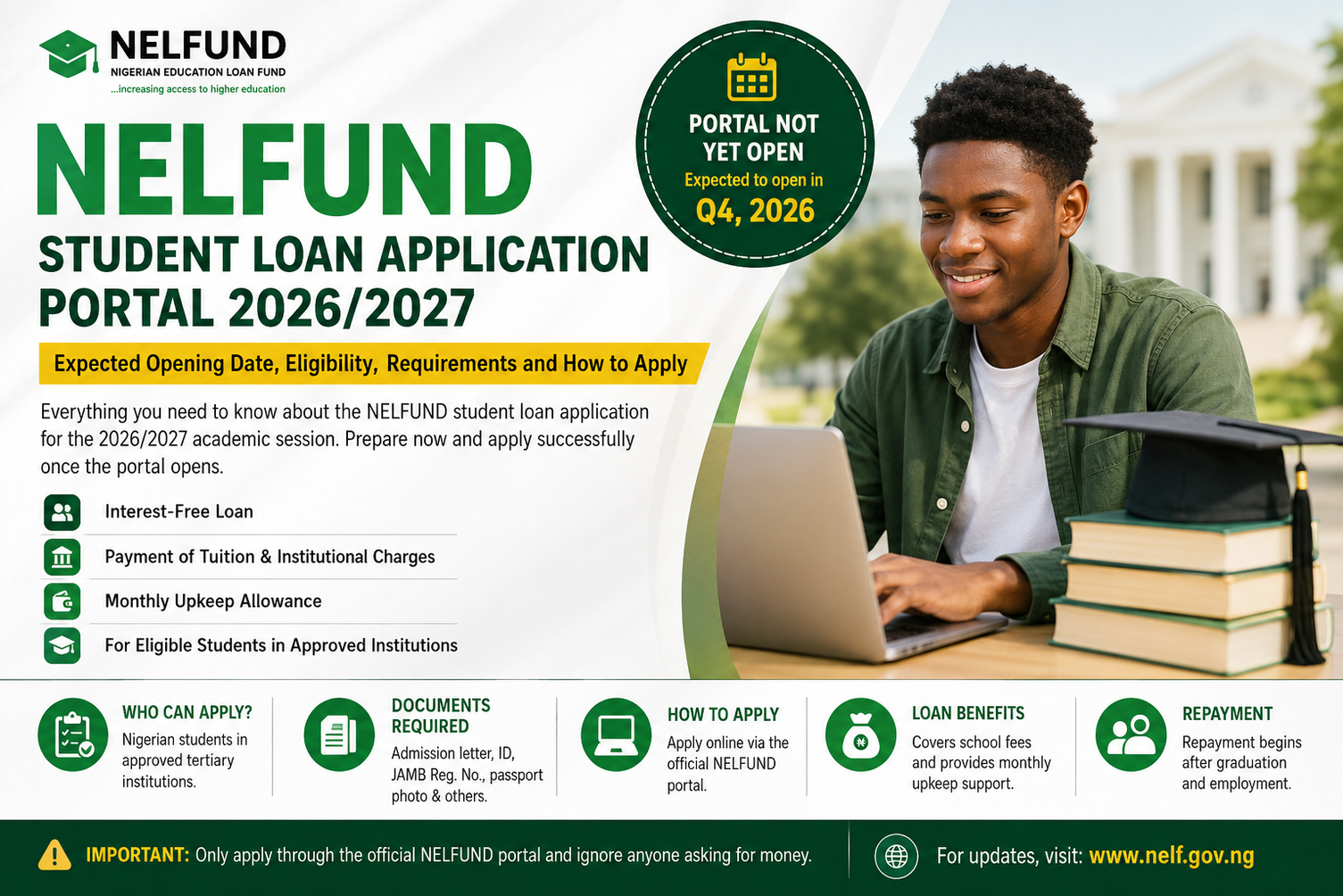
NELFUND Student Loan Application Portal 2026/2027: Opening Date, Requirements and How to Apply
The NELFUND Student Loan Application Portal for the 2026/2027 academic session has not yet been officially opened or announced. However, based on previous application cycles, eligible students can expect another application window once the Nigerian Education Loan Fund (NELFUND) releases its official schedule.
While waiting for the official announcement, prospective applicants should prepare all required documents, ensure their admission details are correct, and understand the application process ahead of time. This guide explains everything you need to know so you can apply successfully once applications begin.
Introduction
Paying for higher education has become one of the biggest challenges facing many Nigerian students. Rising tuition fees, accommodation costs, textbooks, transportation, and other educational expenses have made it difficult for thousands of qualified students to continue their studies.
To address this challenge, the Federal Government introduced the Nigerian Education Loan Fund (NELFUND)—a programme designed to provide interest-free financial assistance to eligible students enrolled in approved tertiary institutions across Nigeria.
Since its launch, the scheme has enabled many students to receive funding for tuition and upkeep, reducing the financial burden on families and allowing beneficiaries to focus on their education.
As interest grows in the next application cycle, many students are searching online for information about the NELFUND Student Loan Application Portal 2026/2027, including when the portal will open, who is eligible, the documents required, and the application process.
At the time of writing, NELFUND has not officially announced the commencement of applications for the 2026/2027 academic session. However, by analysing previous application timelines and official guidelines, students can begin preparing well in advance.
This comprehensive guide covers:
- Whether the 2026/2027 portal is open.
- The expected application timeline.
- Eligibility requirements.
- Documents to prepare.
- Institutions likely to participate.
- How the application process works.
- Common mistakes to avoid.
- Frequently asked questions.
This page will also be updated immediately after NELFUND publishes any official announcement regarding the 2026/2027 application cycle.
Is the NELFUND Student Loan Portal Open for 2026/2027?
No.
As of the time this article was published, NELFUND has not officially announced the opening of the 2026/2027 student loan application portal.
Many students have already started searching for the application portal because admission processes for several tertiary institutions are ongoing. However, it is important to understand that no official application dates have been released yet for the new academic session.
Applicants should therefore be cautious of websites or social media posts claiming that the 2026/2027 application has already commenced unless the information comes directly from NELFUND or another official government source.
Whenever the application window is officially announced, this article will be updated with:
- Confirmed opening date.
- Closing date.
- Application deadline.
- Updated eligibility requirements.
- Newly approved institutions.
- Official application procedures.
Expected NELFUND Application Timeline for 2026/2027
Although the official timetable has not yet been released, previous application cycles provide an indication of what prospective applicants may expect.
The projected timeline below is based on how NELFUND has managed earlier application exercises and should be treated as a guide rather than an official schedule.
| Activity | Expected Timeline |
|---|---|
| Expected Portal Opening | Fourth Quarter (Q4) of 2026 |
| Expected Application Period | Approximately 2–3 months |
| Verification by Institutions | Begins after submission |
| Approval & Loan Processing | Ongoing after verification |
| Disbursement | After successful approval |
Important: These dates are only estimates based on previous application cycles and should not be considered official. Students should always rely on announcements published by NELFUND before making any application.
What Is NELFUND?
The Nigerian Education Loan Fund (NELFUND) is a Federal Government initiative established to improve access to tertiary education by providing financial support to eligible Nigerian students.
The programme was introduced following the enactment of the Student Loans Act and is designed to ensure that financial hardship does not prevent qualified Nigerians from obtaining higher education.
Unlike conventional bank loans, NELFUND focuses solely on educational financing and provides a structured repayment system that begins after beneficiaries have completed their education and are earning an income, subject to applicable guidelines.
Depending on eligibility and prevailing programme rules, the loan may cover:
- Tuition fees.
- Approved institutional charges.
- Monthly upkeep allowance.
- Other approved education-related expenses.
The overall objective is to reduce the number of students who defer or abandon their education due to financial constraints.
Objectives of the NELFUND Student Loan Scheme
The establishment of NELFUND reflects the government’s commitment to improving educational access and human capital development.
Some of the major objectives include:
- Increasing access to higher education for eligible Nigerians.
- Reducing the financial burden on parents and guardians.
- Lowering student dropout rates caused by lack of funds.
- Promoting equal educational opportunities regardless of economic background.
- Supporting national development through investment in education.
- Encouraging students to complete their programmes without unnecessary financial interruptions.
Over time, the scheme is also expected to contribute to a more skilled workforce by enabling more Nigerians to acquire tertiary education and professional qualifications.
Who Is Eligible to Apply?
Although the official eligibility requirements for the 2026/2027 application cycle have not yet been released, previous guidelines indicate that applicants are generally expected to meet the following conditions.
Eligible Applicants May Include:
- Nigerian citizens.
- Students admitted into approved tertiary institutions.
- Undergraduate students studying eligible programmes.
- Newly admitted students who have completed their admission process.
- Returning students who meet institutional verification requirements.
As with previous application rounds, applicants will likely be required to complete identity verification and institutional confirmation before their applications can be approved.
Students should note that meeting the basic eligibility criteria does not automatically guarantee loan approval. Every application is subject to verification by both NELFUND and the applicant’s institution.
Institutions Likely to Participate
Based on previous application exercises, the programme is expected to continue covering students enrolled in approved Nigerian tertiary institutions.
These may include:
Federal Universities
Students admitted into eligible federal universities are expected to remain among the primary beneficiaries of the scheme.
Federal Polytechnics
Eligible National Diploma (ND) and Higher National Diploma (HND) students studying in approved federal polytechnics may also qualify.
Federal Colleges of Education
Students pursuing Nigeria Certificate in Education (NCE) programmes at approved colleges are expected to remain eligible.
State-Owned Institutions
NELFUND has gradually expanded participation in recent application cycles. Additional state-owned universities, polytechnics, and colleges of education may continue to be onboarded, subject to institutional compliance and official approval.
Applicants should confirm that their institution is participating in the scheme before submitting an application once the portal opens.
Documents You Should Prepare Before the Portal Opens
Preparing your documents in advance can help you complete your application more quickly when the portal becomes available.
The following documents are commonly required during the application process:
Personal Information
- Full name (as it appears on official records)
- Date of birth
- Phone number
- Email address
- Residential address
- National Identification Number (where applicable)
Academic Information
- JAMB Registration Number
- Admission Letter
- Admission Number
- Institution name
- Faculty and department
- Course of study
- Current level of study
Supporting Documents
Applicants may also need to upload:
- Recent passport photograph.
- Valid means of identification.
- Student verification documents requested by their institution.
- Any additional documents specified by NELFUND during the application process.
Before uploading any document, ensure that all information is accurate and matches your admission records. Differences in names, registration numbers, or other details may delay verification or result in your application being rejected.
How to Apply for the NELFUND Student Loan 2026/2027
One of the advantages of the NELFUND programme is that the application process is completely online. Applicants do not need to visit any NELFUND office physically to submit their applications.
To improve your chances of approval, ensure you have a stable internet connection, accurate personal information, and all required documents before beginning the registration process.
Step 1: Visit the Official NELFUND Portal
Once applications officially open, visit the NELFUND Student Loan Portal using the official website. https://portal.nelf.gov.ng
Always verify that you are on the genuine NELFUND website before entering your personal information. Avoid clicking links shared by unknown individuals or unofficial social media pages.
Step 2: Create Your Account
If you are applying for the first time, click Register or Create Account.
You may be required to provide:
- Full name
- Valid email address
- Active phone number
- Password
Use an email address and phone number that you check regularly, as important updates will be sent through them.
Step 3: Verify Your Email Address
After registration, NELFUND may send a verification link or code to your email address.
Open your inbox and complete the verification process before logging in.
If you do not receive the email immediately:
- Check your Spam folder.
- Check your Promotions folder.
- Wait a few minutes before requesting another verification email.
Step 4: Log In to Your Dashboard
Once your account has been verified, sign in using your registered email address and password.
Your dashboard is where you will:
- Complete your profile.
- Upload documents.
- Track your application.
- Receive important notifications.
Step 5: Complete Your Personal Profile
Provide your correct personal information exactly as it appears on your official documents.
This usually includes:
- Full name
- Date of birth
- Gender
- State of origin
- Local Government Area
- Residential address
- National Identification Number (if requested)
Any mismatch between your records may delay verification.
Step 6: Enter Your Academic Details
Applicants will also be required to provide information about their education.
You may need to enter:
- Institution name
- Faculty
- Department
- Course of study
- Admission year
- Admission number
- JAMB Registration Number
- Student Matriculation Number (where available)
Newly admitted students may be allowed to use their Admission Number or JAMB Registration Number before receiving their matriculation number, depending on NELFUND’s current guidelines.
Step 7: Upload Required Documents
After completing your profile, upload all requested documents.
These may include:
- Admission letter
- Passport photograph
- Valid means of identification
- Student verification documents
- Any additional documents requested by NELFUND
Ensure all scanned documents are:
- Clear
- Complete
- Easy to read
- Uploaded in the correct file format
Blurry or incomplete documents may delay your application.
Step 8: Review Your Information Carefully
Before clicking the Submit button, carefully review every section of your application.
Check:
- Correct spelling of your name.
- Correct JAMB Registration Number.
- Admission Number.
- Institution details.
- Uploaded documents.
Taking a few extra minutes to review your application can help prevent avoidable mistakes.
Step 9: Submit Your Application
Once you are satisfied that all information is correct, submit your application.
After submission, you should receive a confirmation message or application reference number.
Keep this reference number safe, as it may be required for future enquiries.
What Happens After You Submit Your Application?
Submitting your application does not automatically mean your loan has been approved.
Your application will proceed through several stages before a final decision is made.
Stage One: Preliminary Screening
NELFUND first reviews the information you submitted to ensure your application is complete.
During this stage, they may check:
- Personal information.
- Academic details.
- Uploaded documents.
- Identity verification.
Applications with missing information may remain pending until corrections are made.
Stage Two: Institutional Verification
Your institution plays an important role in the approval process.
NELFUND may request confirmation that:
- You are genuinely admitted.
- Your admission records are valid.
- Your programme is eligible.
- Your tuition details are correct.
Applications usually move faster when institutions promptly verify student information.
Stage Three: Final Assessment
After institutional verification, NELFUND conducts a final review.
This assessment may include:
- Identity confirmation.
- Eligibility checks.
- Duplicate application checks.
- Compliance with programme guidelines.
Only applicants who successfully complete all verification stages are considered for approval.
Loan Approval
If your application is approved, you will receive a notification through your dashboard, email, or SMS.
The notification may include information about:
- Loan approval.
- Tuition payment.
- Upkeep allowance (where applicable).
- Next steps.
Applicants should regularly check their dashboard instead of relying solely on email notifications.
How School Fees Are Paid
One important feature of the NELFUND programme is that approved tuition fees are generally paid directly to the student’s institution rather than into the student’s personal bank account.
Depending on the approved amount and institutional charges, the loan may cover:
- Tuition fees.
- Registration fees.
- Examination fees.
- Other approved institutional charges.
This direct payment system helps ensure that the funds are used for educational purposes.
Monthly Upkeep Allowance
In addition to tuition support, eligible beneficiaries may receive a monthly upkeep allowance, subject to prevailing programme guidelines.
The allowance is intended to help students meet essential living expenses such as:
- Feeding.
- Transportation.
- Internet subscription.
- Study materials.
- Photocopying.
- Practical and laboratory expenses.
The amount and payment schedule are determined by NELFUND and may change from one application cycle to another.
How to Check Your NELFUND Application Status
After submitting your application, you can monitor its progress through your dashboard.
Your application status may display messages such as:
- Draft
- Submitted
- Under Review
- Awaiting Institutional Verification
- Approved
- Disbursed
- Declined
Applicants are advised to log in regularly for updates.
Can You Edit Your Application After Submission?
Depending on the portal settings, applicants may be allowed to edit certain information before verification begins.
However, once an application has entered the verification stage, major changes may no longer be possible.
For this reason, always review your application carefully before clicking the Submit button.
Common Reasons Applications Are Delayed
Many students assume every delay means rejection.
In reality, applications can remain pending for several legitimate reasons, including:
- Delayed verification by the institution.
- Incomplete documents.
- High volume of applications.
- Incorrect personal information.
- Mismatch between admission records and submitted details.
- Technical issues during processing.
Applicants should remain patient while monitoring their dashboard for updates.
Expert Tips to Increase Your Chances of Approval
Although approval depends on NELFUND’s assessment, the following tips can help you avoid common mistakes:
- Apply as soon as the portal officially opens instead of waiting until the deadline.
- Ensure your names match all official documents.
- Use an active email address and phone number.
- Upload only genuine and readable documents.
- Double-check every detail before submission.
- Avoid creating multiple accounts.
- Respond quickly to any request for additional information.
Early preparation often makes the application process smoother and reduces the likelihood of unnecessary delays.
Benefits of the NELFUND Student Loan
The Nigerian Education Loan Fund (NELFUND) is one of the Federal Government’s major initiatives aimed at reducing the financial burden of higher education on Nigerian students and their families. While the programme continues to evolve, it offers several benefits to eligible applicants.
1. Interest-Free Student Loan
One of the biggest advantages of the scheme is that approved student loans do not attract commercial interest like traditional bank loans. This makes repayment more affordable for beneficiaries after completing their studies.
2. Payment of Tuition Fees
Rather than paying tuition funds into students’ personal accounts, approved institutional charges are generally paid directly to participating institutions. This ensures that the funds are used for their intended educational purpose.
3. Monthly Upkeep Support
Depending on the applicable guidelines and approval, eligible students may receive a monthly upkeep allowance to help cover essential living expenses such as:
- Feeding
- Transportation
- Internet subscription
- Academic materials
- Research expenses
- Personal educational needs
4. Reduced Financial Pressure on Families
Many parents and guardians struggle to meet the increasing cost of tertiary education. The NELFUND scheme helps ease this burden, allowing families to focus on other essential responsibilities.
5. Improved Access to Higher Education
Financial challenges are one of the leading causes of student dropout in Nigeria. By providing educational financing, NELFUND enables more qualified students to enrol in and complete their tertiary education.
6. Better Academic Performance
Students who are less worried about tuition and living expenses can devote more time and attention to lectures, assignments, research, examinations, and skill development.
Common Reasons NELFUND Applications May Be Rejected
Although many applicants qualify, not every application receives approval. Understanding the common reasons for rejection can help you avoid mistakes when the portal opens.
Some of the most common reasons include:
- Incorrect personal information.
- Mismatch between admission records and submitted details.
- Incomplete application forms.
- Missing required documents.
- Uploading blurred or unreadable files.
- Providing false or misleading information.
- Failure of institutional verification.
- Duplicate applications using different accounts.
- Applying through unofficial websites.
If your application is unsuccessful, carefully review any feedback provided by NELFUND and correct eligible errors before reapplying if another application window becomes available.
Common Mistakes Applicants Should Avoid
Many delays and rejections are caused by avoidable mistakes. Before submitting your application, keep the following in mind:
Waiting Until the Deadline
Submitting your application early gives enough time for corrections, institutional verification, and document review.
Using Incorrect Details
Always ensure that your:
- Name
- Date of birth
- JAMB Registration Number
- Admission Number
- Institution details
match your official records exactly.
Uploading Fake Documents
Submitting forged or altered documents may result in immediate disqualification and possible sanctions.
Ignoring Email Notifications
Important requests for additional information or verification may be sent through your registered email address or dashboard. Check them regularly.
Applying More Than Once
Creating multiple accounts or submitting duplicate applications may delay processing or lead to rejection.
How to Avoid NELFUND Scams
As the popularity of the student loan programme continues to grow, fraudulent individuals may attempt to exploit unsuspecting applicants.
To stay safe:
- Apply only through the official NELFUND portal.
- Never pay anyone who claims they can guarantee approval.
- Ignore unofficial WhatsApp groups requesting payment.
- Do not share your password or One-Time Password (OTP) with anyone.
- Verify every announcement through official NELFUND communication channels.
Remember that legitimate application updates will come directly from NELFUND.
Understanding the Loan Repayment Process
One of the most attractive features of the NELFUND programme is its structured repayment system.
Repayment is generally designed to begin after beneficiaries have completed their studies and are earning an income, in line with the applicable legal and operational guidelines.
The exact repayment process may vary depending on future policy updates.
For Salaried Employees
Graduates who secure paid employment may repay the loan through deductions or other approved repayment arrangements as provided under the programme guidelines.
For Self-Employed Beneficiaries
Self-employed graduates are also expected to fulfil their repayment obligations through approved payment channels once they begin earning income.
The repayment structure is intended to ensure that beneficiaries are not required to repay the loan while still studying.
What If You Cannot Repay Immediately?
The student loan scheme is designed with flexibility in mind. However, beneficiaries are expected to comply with repayment obligations once they become eligible under the programme.
Applicants should stay informed about the latest repayment policies issued by NELFUND after graduation.
Will More Institutions Join the Programme?
The Federal Government has continued expanding participation in the student loan scheme.
In future application cycles, additional institutions may become eligible, including:
- More state universities.
- State polytechnics.
- State colleges of education.
- Technical institutions.
- Other approved tertiary institutions.
Students should confirm their institution’s participation before applying.
Why the NELFUND Student Loan Is Important
The introduction of NELFUND represents one of Nigeria’s most significant education financing reforms in recent years.
If properly implemented, the programme has the potential to:
- Increase university enrolment.
- Reduce student dropout rates.
- Improve access to tertiary education.
- Produce more skilled graduates.
- Strengthen Nigeria’s workforce.
- Support long-term national development.
For many students from low-income families, the scheme provides an opportunity to complete their education without excessive financial hardship.
Frequently Asked Questions (FAQs)
Is the NELFUND Student Loan Portal Open for 2026/2027?
No. As of the time this article was published, NELFUND has not officially announced the commencement of applications for the 2026/2027 academic session.
When Is the Portal Expected to Open?
Based on previous application cycles, the portal may open later in 2026. However, applicants should wait for an official announcement before relying on any dates.
Who Can Apply?
Eligible Nigerian students studying in approved tertiary institutions are expected to qualify, subject to the official guidelines for the 2026/2027 application cycle.
Can Newly Admitted Students Apply?
Based on previous application exercises, newly admitted students may be eligible to apply after meeting the required admission and verification conditions.
Is the Student Loan Interest-Free?
Yes. The programme is designed as an interest-free educational loan for eligible beneficiaries.
Will School Fees Be Paid to Students?
No. Approved tuition and institutional charges are generally paid directly to the beneficiary’s institution.
Will Students Receive a Monthly Allowance?
Eligible beneficiaries may receive a monthly upkeep allowance in accordance with NELFUND’s current operational guidelines.
Can HND and NCE Students Apply?
If their institutions are approved and they meet the eligibility requirements, they may qualify under the programme.
Can I Apply More Than Once?
No. Applicants should submit only one application to avoid delays or possible rejection.
How Will I Know If My Application Has Been Approved?
Successful applicants are expected to receive updates through their dashboard, registered email address, SMS, or other official communication channels.
Is There an Application Fee?
Applicants should not pay anyone claiming to process or guarantee approval. Always follow instructions published through official NELFUND channels.
Conclusion
The NELFUND Student Loan Scheme continues to provide hope for thousands of Nigerian students seeking financial support to pursue higher education.
Although the 2026/2027 application portal has not yet been officially announced, prospective applicants can use this period to prepare all necessary documents, verify their admission details, and familiarise themselves with the application process.
Applying early, providing accurate information, and following only official updates can significantly improve your chances of a successful application once the portal opens.
MasterCareer.com.ng will continue to monitor announcements from NELFUND and update this guide immediately after the official application dates, eligibility requirements, and registration procedures for the 2026/2027 academic session are released.
Recommended Posts;
Nursing Cut-Off Mark for 2026/2027: JAMB Score Required for Admission into Universities and Colleges
UNIPORT Cut Off Mark 2026/2027 for All Courses: Departmental &Post-UTME Scores (Updated)
University of Lagos (UNILAG) Recruitment 2026: Apply for 34 Academic and Non-Academic Vacancies
FUOYE Courses and Cut-Off Mark for 2026/2027: Full List & Admission Requirements
UNN Courses and Cutt-off marks 2026/2027: Full list & Admission Update
Ahmadu Bello University (ABU) Zaria Cut-Off Marks 2026: Full Admission Guide For All Courses
UI Cut-off Marks For 2026/2027 Admission| Full List of Courses For All Foculties